

- Description
- Author
- Additional information
Description
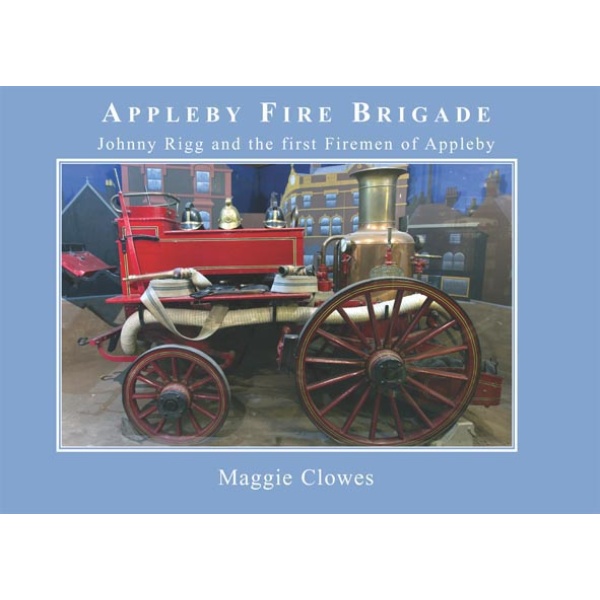
Johnny Rigg and the first firemen of Appleby
Reviews:
Maggie Clowes has based this small book on research by the late Graham Coles. The principal sources are the scrapbooks and family papers of the Whitehead and Heelis families, supplemented by information which the author has found in local newspapers. John Rigg, the central character in the book and a founder member of the fire brigade also served the community as a JP, county councillor and mayor of the borough of Appleby (Westmorland). He was involved in the creation of the brigade and served as its captain for 27 years.
From the beginning of the eighteenth century the government required every parish to provide itself with a means of fighting fires, usually informally using volunteers. After several fires in Appleby in the mid-century pressure grew to provide the ‘ancient borough of St Lawrence’ with a fire engine. The population of Appleby, even in 1881, was fewer than 1500 and only 2900 if the adjoining parish of Bongate was included. In 1879 Sir Henry Tufton, the lord of the manor, paid for a fire engine to serve the town and neighbouring outlying villages. Volunteers were recruited, helmets were bought in 1883, and by 1890 the volunteer brigade had a full uniform. The book reveals the continuing involvement of the Rigg family and describes a number of fire incidents to which the Appleby fire fighters were called. A fire station was opened in 1901 and in 1926 responsibility for the brigade was transferred from the borough to Westmorland County Council.
The book is well presented, with nineteen photographs and other illustrations. The text (32 pages) describes how a fully-equipped volunteer brigade was formed in the small county town of Westmorland. It will be of interest to local people and others interested in the history of Westmorland and the Appleby area in particular. It may also contribute to the more general history of fire fighting in the nineteenth century. Margaret Shepherd, emeritus fellow of Wolfson College, Cambridge, for the British Association for Local History.
This book tells of Brave Men in Blue Tunics with Belts and Brass Buttons, and Shining Helmets, galloping to the rescue on their two and a half ton Merryweather Fire Fighting machine with its steam driven pump, mechanic and stoker and horseman driving the tandem of noble steeds. It tells of the local militiamen who turned firemen, once the 1859 threat of invasion from Napoleon III was over and how Appleby, resistant as ever to innovation, obeyed the Fire Engines Act of 1707 and formed a Fire Brigade – 172 year later, in 1859.
The book tells how they drove like the wind to fires in town and country, even as far as Shap (one hour by Fire Engine), their horses and engine out-performing Penrith’s and how their initial demo drenched several civilians and numerous dogs. It also relates how the money-cautious council submitted them to financial finaglings (no such thing could ever happen nowadays!) but undeterred the Brigade did their duty. The only memorial to them is the three-lion emblem set in stone outside the Riverside Health Centre. Their faithful Merryweather Engine (‘the Tufton’) went for scrap in 1927, without ceremony. The town would never again thrill to the sight of John Rigg on the driver’s seat, handling horses and galloping hell for leather to a fire.
Today, we have brave men yet and we salute their successors, the members of the Cumbria Fire and Rescue Service. Maggie Clowes, writing in memory of the late Graham Coles, has written such a book as calls us to stand up tall and salute to John Rigg and his Firefighters. Revd. Peter Norton, former civil defence heavy rescue squad and former vicar of Appleby-in-Westmorland.
Author
Maggie Clowes
Additional information
| Weight | 135 g |
|---|