
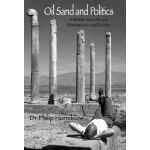
Oil, Sand and Politics
£20.00
New paperback edition of this classic real life story of a doctor, mountaineer and soldier who helped set up the first health services in the Middle East.
- Description
- Author
- Additional information
Description
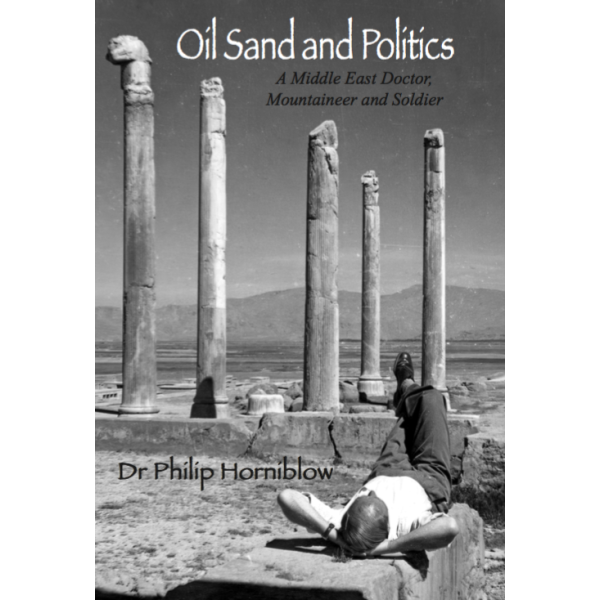
Oil, Sand & Politics: A Middle East Doctor, Mountaineer and Soldier
Dr. Philip Horniblow
new paperback edition
A book jacket can never hope to capture the extraordinary life of mountaineer, ex-paratrooper, spy and expedition doctor, Philip Horniblow, whose fascination with Arabia stemmed from his father’s school friend T. E. Lawrence. The stories about Lawrence of Arabia left a young Philip with ‘sand in his shoes’ and a love of the desert.
This took him to the Middle East where for 30 years he not only organised health care in several Arab states but also undertook some distinctly unofficial work for HM Government working with the SAS and the Arab Legion. He was briefed in London by the intelligence services and given paper and chemicals to write letters to a fictional aunt… it turned out London had sent him off with the wrong chemicals!
His experience in the Arab world, his medical and military training all helped him organise the hospital service in 1950s Saudi Arabia. He writes about many characters including ‘Admiral’ Geoff Douglas, also known as First Dead Sea Lord, a former Royal Marine who served in 21 SAS. The author died in 2020 and this book is a paperback version of the original, now out of print, hardback edition.
“THANKS to an observant, medically trained eye and a retentive ear, Philip Horniblow has caught the atmosphere of 1940s to ’60s Middle East in full measure, while his descriptions of the people he met and situations in which he found himself make for hilarious reading.
“The book isn’t all sandy sojourns, prescribing poultices and SAS skulduggery. Horniblow’s love of the desert peoples and his knowledge of their way of life make him an excellent cultural guide. And his need to cool off (literally) saw him wandering in the Himalaya, where he treated some of the boldest climbers of the day. This is really the story of an ordinary man’s life, but it’s some kind of ordinary.”
Review by “Geographical”, the magazine of the Royal Geographical Society
“Fifty years after we played ‘Boy Scouts’ together and 40 after I tried to get him to write about his experiences in Arabia, I see he has finally done it. It was always my belief that he would overstep the mark. But the fact that he has done so – and survived – makes the latter years even more interesting.” Julian Blackwell, Chairman Blackwells Books.
Lawrence of Arabia:
Asked to write an obituary of Dr Philip Horniblow I was thinking back to how I first got to meet such an extraordinary man. It began with a Pennine blizzard, an empty cottage and a broken door. Bleathgill Edge at 1,200 feet asl belonged to Robert Swan, OBE, (born 1956) first man to walk to both South and North Poles. I’d never met him but the door had blown open and the kitchen was full of snow, so I left a note and managed to pull the door shut. A few weeks later he returned, visited and promptly offered me a job helping organise his life.
Swan was planning future expeditions with Major Michael Patrick ‘Bronco’ Lane, MM, BEM (born 1945) a former British Army officer. Lane climbed Everest with John Henry Stokes, MBE, BEM (28 August 1945-10 January 2016), known as ‘Brummie’, also a soldier and mountaineer. It was a joint British-Royal Nepalese Army expedition and the first successful SAS ascent of Everest in 1976. Dr Philip Horniblow was team doctor on this and other expeditions in the Himalaya and Afghanistan.
His medical services were urgently needed and he performed one of the highest operations in the world. Horniblow had clambered through the treacherous Khumbu icefall to the advance camp in the Western Cwm to be told that Corporal Basantakumar Rai, known as Basant, of the 7th Gurkhas had developed a prolapsed intestine, and was in a lot of pain one stage higher up the mountain. Luckily Stokes was an SAS-qualified nurse so Horniblow packed instruments into a rucksack and the pair set off up the Cwm.
The operation was carried out with minimal sedation as Basant’s howls of pain echoed down to the lower camp. Basant, a stoic Gurkha, eventually returned to base camp under his own steam. Stokes and Lane reached the summit after climbing through storm conditions that obliged them to bivouac overnight in the open. It took all their SAS training to survive. Both suffered severe frost injuries to hands and feet, losing toes and fingers; Stokes was snow blind as others reached them to help them down from the ‘death zone’ above the South Col. The story of this expedition is told in another Hayloft book “Military Mountaineering”.
Horniblow was born on 19 May 1928 in Eastbourne, where his father, Arthur, was a dental surgeon. Horniblow senior joined the Royal Army Medical Corps at the beginning of World War One and by 1915 was in Cairo. His son explained: “This was because of his earlier friendship with T. E. Lawrence at Oxford High School. They had gone cycling together during school holidays and I recall father telling me in the 1950s, “Huh! Say what they like – that man’s stamina WAS phenomenal. We would set out each morning and by lunch time I’d be exhausted. I’d call a halt, T.E. would consult his map, name a town or village miles ahead and I’d get on a train with my bike. That evening when I got off at the agreed station… there he would be waiting for me!
“In 1915 T.E. had suggested father might like to give some medical backup to his imminent foray into the Arabian Peninsula – not so far-fetched as you might think, toothache is no respecter of persons and he had learned that Prince Feisal had dental problems. In Cairo father contracted malaria and typhoid fever, at the same time. He was lucky to survive, was shipped back to the UK and that was the end of his dreams of adventure.
“When he had recovered it was off again, this time to a hospital in France where he met my mother Julia (née Miller-Wilson). She was the victim of ‘shell shock’ – she had been in a forward dressing station near Vimy Ridge when it was bombarded… and the two of them managed to be on leave in Amiens in March 1918 when the Germans advanced and over-ran the hospital where they should have been working. So, here I am.”
Horniblow continued: “When, out of 66 ancestors on my father’s side, I discovered 34 were either soldiers or doctors or both, and my mother was a Nursing Sister in the Canadian Expeditionary Force that went to France in 1915, I suggest there was at least a genetic disposition that would be hard to overcome. “On my mother’s side a Scottish grandfather who – after emptying his bank account – told his wife (his second) that he was just ‘stepping outside to buy a paper’, never stepped back in again. He was traced to the Calais boat train at Victoria Station, then lost.
“On my father’s, a great-grandfather who practised medicine in Leamington Spa and was known for his diagnostic acumen, as the following shows. Summoned to the bedside of an aristocratic lady of the town, he was ushered into the bedroom and tripped over the carpet. “Whoops,” he muttered, sotto voce, but loud enough for the maid to hear, “drunk again.” “Yes Sir,” whispered the maid, “I’m afraid she is.” These anecdotes were told to Horniblow by his paternal aunts, two of whom had achieved high ranks in the First World War – one was Commandant of Queen Mary’s Auxiliary Ambulance Corps, the other commanded the Women’s Transport Corps. Only one of the six sisters married – with the loss of a million men in the war there weren’t enough men to go round.
Philip missed the chance of meeting Lawrence of Arabia on his seventh birthday. “Father had written to him to say he would be coming to Cloud Cottage, but when we arrived and knocked at the door there was no reply.” Father said: “Ha! Typical of T.E! He hasn’t changed, never could be bothered to keep appointments. We’ll wait…” But he never came. It was the 19 May 1935 and T.E. lay dead or dying in hospital after his motor cycle accident.
Horniblow was educated at Lancing College and joined the Parachute Regiment immediately after the Second World War. He was determined to forge a military career but his father thought otherwise, persuading him out of the army and redirecting him towards medicine. His training was at Middlesex Hospital as a mature student, but he “kept one toe in the military” by becoming attached to the 21 SAS Artists Rifles territorial regiment.
His interest in the Middle East came from his father’s friendship with Lawrence. “It rubbed off as a very profound interest for me. The whole region was quite magical,” he said. Horniblow’s passion for climbing was inspired by David Somervell, a friend at medical school and son of Howard Somervell (16 April 1890-23 January 1975) surgeon, painter and mountaineer on two 1920s expeditions to Everest.
As cold war spread across the Middle East in the 1960s, Horniblow became a natural candidate for government interest. A former soldier with an eye for clandestine operations, keenly fascinated by the Arab world and newly qualified as a doctor, he had sound credentials to be a spy for British interests. Time spent as a mountaineer in the Alps and the Himalaya added to his image as someone who would have useful views and information about a complex and developing part of the world.
Tall and powerfully built Horniblow spent 30 years in the Middle East organising health care in several Arab countries – his job to build a network of hospitals from a blank slate. There were no doctors, nurses and barely any trained staff. When Sheikh Zayed took over as Ruler of Abu Dhabi in 1966, up sprang hospitals, doctors were recruited and modern healthcare was introduced.
Horniblow was part of this wave from 1966 to around 1970 as the first director of Abu Dhabi’s health service. He organised the vaccination of 3,000 children in Lebanon at risk from malaria and tuberculosis. Horniblow brought the first X-ray machines to Abu Dhabi, and oversaw a study that found malaria could travel between Abu Dhabi and Dubai because mosquitoes could breed in dew that persisted in wheel rims.
Horniblow chronicled the immense task in his 2003 memoir, ‘Oil, Sand and Politics’ (reprinted in paperback due out early 2023) and recounted how when Sheikh Zayed cut his foot on coral – which can have dangerous consequences – he deliberately sought out the local service to show confidence in it. The book chronicles his time with the Arab Legion in Jordan, the Pakistan Army, the Abu Dhabi Defence Force and the Sultan of Oman’s Armed Forces, all the while introducing the latest western medicine to the traditionalist Arab world newly awash with oil dollars. His military background and growing expertise made him a useful man. He wrote: “You will have gathered I was not in Saudi Arabia entirely at my own behest but had undertaken to keep [the British government] informed of any titbits of information I picked up while on my daily rounds.”
Adventure persisted. In what became known as a “war that never was” in Yemen in the early 1960s, Horniblow acted as interpreter for a senior British officer visiting the front line when they came under fire. The senior officer dived for cover and Horniblow hid behind a wall but he and the donkey accompanying them were wounded by flying shrapnel. With just one wound dressing between them, Horniblow weighed a pragmatic choice. He used the dressing on the donkey, since it was probably more important the animal should be able to carry him back to safety.
Horniblow was also the medical officer who flew with an Abu Dhabi Defence Forces humanitarian mission to Jordan in 1970 at the beginning of the conflict there. During his thirty-year spell in the Middle East, he also met the Bin Laden family of Saudi Arabia.
He finally returned to the UK aged 50 and, with his wife Binnie (née Lash) whom he married in Beirut in 1961, and their daughter Kathy, a photographer, moved into an old vicarage in Somerset; Binnie and Kathy both survive him. He and Binnie had met in Kuwait during an amateur production of ‘Blithe Spirit’ by Noël Coward. Binnie was the stage manager while Horniblow played the male lead; at one point the spectral ghost had to run her fingers through his hair and compare it to golden silk, which brought the house down because Horniblow was, by then, almost bald!
A devoutly Christian man, after his return to the UK he was head of the radiology department at Yeovil District Hospital and subsequently became the hospital’s medical director. He was a driving force in the Yeovil Environs Scanner appeal, which raised £1.3 million to provide the hospital with its first CT scanner. Beyond medicine and mountaineering his main hobby was painting, which he loved to attempt even though the results were generally deemed by his family to be less than professional. Amateur dramatics and singing hymns were also interests he pursued with great energy.
Philip Horniblow, OBE, mountaineer, soldier and doctor died of pneumonia and complications from dementia on 13 August 2020, aged 92.
SOURCES: Dr P. Horniblow, ‘Oil, Sand and Politics’ (2003); Dr P. Horniblow, ‘Oil, Sand and Politics’ (2023); personal knowledge (2003); private information (2003 and 2022); The Times, (21 August 2020)’ National News (UAE), (23 August 2020)
Author
Dr Philip Horniblow
Additional information
| Weight | 700 g |
|---|---|
| Dimensions | 16 × 24.5 cm |